
Types of FIP and Diagnosis
There is no specific test for FIP. Veterinarians evaluate the cat’s symptoms, perform tests, and rule out other conditions to arrive at a probable diagnosis.
There is no specific test for FIP. Veterinarians evaluate the cat’s symptoms, perform tests, and rule out other conditions to arrive at a probable diagnosis.
If FIP is suspected, you can use treatment as a way to confirm the diagnosis. The medication will only work if the cat has FIP, so if the cat improves while taking it, the diagnosis is confirmed.
FIP generally occurs in cats younger than 24 months and older than 15 years. Symptoms include loss of appetite, lethargy, and a lack of interest in play, and the disease may be accompanied by fever or episodes of fever.
Whenever FIP is suspected, a complete blood count with biochemical panel is necessary, and a proteinogram should be performed if possible. The blood test will likely show low albumin, high globulin, a high white blood cell count, a low red blood cell count, high neutrophils, high protein, and high bilirubin.
Not all blood test results will be the same; however, if certain markers are present and the cat’s symptoms suggest a possible diagnosis of FIP, further diagnostic testing is generally recommended.
Among the different types of FIPs, we find:
The dry form of Feline Infectious Peritonitis (FIP) is difficult to diagnose and is also the form that progresses most slowly.
To diagnose a dry FIP, blood tests with biochemical analysis and an ultrasound are required: since FIP is an inflammatory disease, we will find thickened walls, affected liver, kidneys, etc., and enlarged abdominal lymph nodes.
During the ultrasound, it is recommended to perform a lymph node tissue biopsy. In this biopsy, it is normal to find macrophages, neutrophils, or proteins. This tissue can also be sent to the IDEXX laboratory, where they are able to identify two of the FIP mutations (there are many more). If the IDEXX PCR test is positive, even if the two mutations test negative, the result is still considered positive for FIP.
In this case, the following tests are required: blood work with biochemical analysis, an ultrasound, a fluid sample for cytology, and an IDEXX PCR test. The cytology results may show macrophages, neutrophils, and proteins.
In cases of abdominal effusion, drainage is not recommended unless the fluid is compressing the chest and interfering with the cat’s breathing. The reason for not draining the fluid is that it will reappear and could affect the balance of electrolytes and proteins.
Diuretics are also not recommended, unless the patient has heart disease.
In the case of fluid-filled serous effusions, it is important to note that proteins can become diluted in the fluid, causing globulins, albumin, and total protein levels to fall within normal ranges above 0.6 or even 0.8.
The acute form of feline infectious peritonitis tends to progress very rapidly, so it is recommended that treatment be started immediately.

Pleural effusion is often associated with varying degrees of shortness of breath.
The tests to be performed are the same as those for ascites. The difference with an abdominal effusion is that, in this case, the pleural cavity must be drained to allow the cat to breathe properly and prevent a possible cardiac arrest.
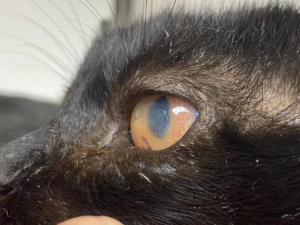
It can occur in conjunction with any of the above conditions and is observed when the FIP has crossed the blood-brain barrier; in these cases (especially neurological ones), laboratory test results may appear normal—perfectly normal.
The following tests should be performed: blood work with biochemical analysis, ultrasound, and a CT scan or MRI if financially feasible. If the pressure allows it, and provided the treating veterinarian deems it appropriate, a lumbar puncture (CSF) could be performed for cytology and PCR; if the condition is ocular, cytology and PCR of the aqueous humor can be performed.
Lupín has neurological FIP, anemia, and neutrophilia, but his blood chemistry is normal. When he was diagnosed with FIP, he couldn’t move.
He wasn’t eating.
After just three days of treatment, she began to suck on her food. She still couldn’t control her movements—not even her head.
After just 6 days of treatment, he was out of the incubator!!
By the time his treatment was over, Lupín was almost back to normal. The only lingering effects were a slight limp in his hind legs and the need to help him empty his bladder. Other than that, he’s a playful little charmer!
Do you suspect your cat might have FIP, or do you need more information about the different types and diagnosis? Fill out the form, and our team will contact you as soon as possible.